How many users does a usability test need? Why 5 isn't always the answer
How many participants does a usability test need? About 5 users find ~85% of problems, but here is when you need more, with the research behind the numbers.
Published June 19, 2026
Your designer says five testers is plenty. Your manager wants twenty. One of them is wasting effort. But which one?
For the most common kind of usability test, where you watch one kind of user attempt real tasks to find what trips them up, about 5 users will surface roughly 85% of the problems. That comes from Jakob Nielsen and Tom Landauer's research, and it's why "test with 5" became a rule of thumb.
Where the "5 users" number comes from
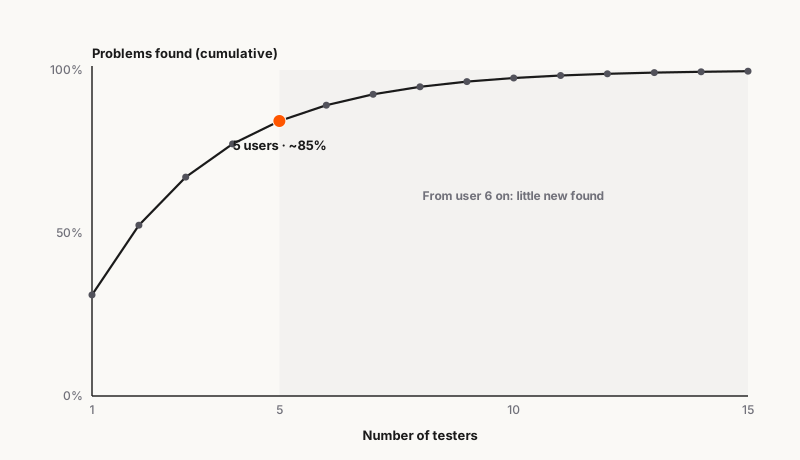
In 1993, Nielsen and Landauer modeled how problems get discovered as you add testers. Each user finds some fraction of the total, on average about 31%, and each new person overlaps with the ones before. Run the math (1 − (1 − 0.31)ⁿ) and the curve climbs fast, then flattens:
| Testers | Problems found (avg) |
|---|---|
| 1 | ~31% |
| 3 | ~67% |
| 5 | ~85% |
| 10 | ~98% |
| 15 | ~99% |
The first few users find most of what's there. By the fifth, you're mostly watching people trip over issues you've already noted. A sixth and seventh tester cost the same as the first but teach you far less. That's diminishing returns.
So five is usually right. But that 85% is an average, for one user group, hunting qualitative problems. The moment your goal changes, the right sample size changes too. Put a number on it, compare two designs, or serve very different audiences, and five stops being the answer. The real rule was never "5 users." It's test a few, fix what you find, and test again.
The real rule: test, fix, repeat
The part the "5 users" headline buries is this. Nielsen's actual advice was never to run one big test. It was to test small and often.
Three rounds of 5 beat one round of 15. After the first 5, you fix what you found, which changes the product, which exposes problems that were hidden behind the first set. A single 15-person test on a frozen design just keeps re-finding the same top issues. Iteration uncovers new layers; piling users onto a static design doesn't.
But which five you get matters
There's an honest catch. "5 users find 85%" is an average. Averages are easy to trust, and that's the trap: they hide how much the real number swings underneath.
In a 2003 study, Laura Faulkner tested 60 users on one product, then recalculated the results for random groups of 5. The luckiest group of 5 found 99% of the problems. The unluckiest found just 55%. Same product, same test, different five people.
More users tightens that floor:
| Group size | Worst-case problems found (Faulkner, 2003) |
|---|---|
| 5 users | at least 55% |
| 10 users | at least 80% |
| 20 users | at least 95% |
So when the cost of missing a problem is high, like a checkout flow or a medical form, and you can't run multiple rounds, lean toward 8-10 rather than a bare 5. You're buying down the risk of an unlucky draw.
When 5 isn't enough
The 5-user rule is for finding qualitative problems in one user group. Step outside that, and the number climbs:
| Your goal | Participants | Why |
|---|---|---|
| Find usability problems (qualitative) | ~5 per group, then iterate | Diminishing returns past 5 |
| Put a number on it (task time, success, SUS) | 20 minimum, ~40 for a tight result | Statistics need sample size; NN/g suggests ~40 for a 15% margin at 95% confidence |
| Very different user groups (admins vs end users) | 3-5 per group | Different groups hit different problems |
| Card sorting (information architecture) | ~15 | Agreement between sorts stabilizes around 15 |
| Eye-tracking heatmaps | ~39 | Gaze patterns need volume to settle |
The pattern: qualitative "why" questions need only a handful of people. Quantitative "how much" questions need statistical power, so they take far more. Most teams confuse the two, either over-recruiting for a quick qualitative test or under-recruiting for a number they then want to trust.
So how many participants do you actually need?
Strip it down to your goal:
- Finding problems, one audience? Start with 5. Fix. Run another 5.
- Two or three distinct audiences? 3-5 of each.
- High-stakes flow, only one shot? 8-10, to cover the unlucky draw.
- A number you'll report or compare? Budget for 20-40.
For most projects, the refrain is the same: test small, fix, repeat. The catch is that doing it that often is hard. One test leaves a pile of notes and a recording, and sorting, tagging, and pulling them into a report takes longer and wears on you more than you'd expect. Dreading that write-up is what makes the next round slip, until the habit quietly dies.
When each round's write-up shrinks to almost nothing, "test, fix, repeat" becomes realistic. That's the loop Interbang is built around: each note stays pinned to what the tester was saying at that moment, and measures like success rates are already tallied when the session ends.
So the number to remember isn't 5. It's enough to learn something, cheaply enough to do it again. Which tools make that loop painless is its own comparison, picked by the job you're doing.
Frequently asked questions
Is 5 users enough for a usability test? For finding qualitative problems in one user group, usually yes. About 5 users reveal ~85% of issues, and you learn more by fixing those and testing again than by adding a sixth. It's not enough when you need statistics, you serve very different audiences, or a missed problem is costly.
Can I trust a success rate from just 5 users? As a directional read, yes. Even 5 users give you a number like "4 of 5 succeeded," a quick signal alongside the qualitative "why." Usability testing is grounded in the qualitative, with these numbers as support. But the sample is too small to treat them as statistically solid, or to compare two designs by the numbers. For figures you can stake a decision on, you need at least 20 users, around 40 for tighter results (NN/g).
What if my product has very different types of users? Test 3-5 people from each distinct group rather than 5 total. Admins and end users, buyers and sellers, beginners and experts often trip over different things, so a blended 5 can miss problems that only one group hits.
Is testing 5 users once enough, or do you have to repeat? If you care about shipping something people can actually use, keep testing. Usability testing is one of the cheapest, fastest ways to make a product better.